Showing posts with label justification. Show all posts

6/11/09

Small Group Leaders Need to Repent

Matt Chandler's sermon from this past weekend was good. That boy can preach. I know it is a good sermon if I am making excuses for myself by the end of it. Here is a quote from the end of this sermon (probably not exact):

"You good husbands, you good fathers, you small group leading, church going, morally righteous men and women, you need to repent . . . . We say I am a better man than my father was, I am a good man to my wife and children, I am a good mother, I am a hard worker, I am involved at church, and Jesus says "REPENT!", that does not save you, that does not justify, and it is just as God mocking as anything out there."

His point is that religion doesn't save anybody, being a good person doesn't save, even obeying the Bible and loving others doesn't save. The work of Christ, his death and resurrection, saves all whom God chooses to regenerate. There is no other way, and no amount of human effort will help our situation (Rom 9:16). We are completely dependant upon God.

After all, the best we can offer God is filthy rags(Isa 64:6). So, if we continue to do good, or even if we do great things and help millions of people in the name of Christ, we are just making a mountain of dirty dish towels to lay before the feet of God. Also, we run the risk of being just like the group of good deed doers who are told that their deeds do not equal salvation (Matt 7:22-23).

If we want to make an effort, then we don't need to look to any rules or good deeds. Obedience and good deeds are only godly whenever the flow from the Spirit's work in our life as we reflect upon the cross of Christ. We have to continually look to the cross and the person of Jesus. He is our only hope.

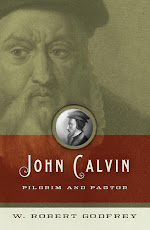
As Calvin, in his Institutes and Romans Commentary, stated:
"Christ has been given to us for righteousness; whosoever obtrudes on God the righteousness of works, attempts to rob him of his office. And hence it appears that whenever men, under the empty pretence of being zealous for righteousness, put confidence in their works, they do in their famous madness carry on war with God himself."

"But if we are chosen in him, we shall find no assurance of our election in ourselves, nor even in God the Father, considered alone, abstractly from the Son. Christ, therefore, is the mirror in which we must contemplate our election."

Read more...

3/24/09

A Break from Galatians

This past Sunday, at Remedy Church, Phud (the teaching pastor) detoured from the book of Galatians to continue discussing the doctrine of Justification.  I don't think it is possible to overstate or spend too much time on this doctrine. Therefore, I stayed in my seat and listened to the Word preached.  


He preached Luke 7:36-50 and identified five correct responses to a proper understanding of Justification.  Here is the outline:

----- 5 Responses to Justification (Luke 7:36-50) -----

1) A believer who understands God's forgiveness loves "sinners" (37-39)
  • If you understand forgiveness and justification, then you know that you were, and still are, a dirty, rotten sinner
  • A proper response is that we will want to be around nonbelievers (1 Cor. 9:19-23)
  • We are all sinners; Christ loved sinners
2) A believer who understands God's forgiveness stops trying to repay God for being forgiven (41-43) 
  • We could not earn salvation, we cannot repay justification, and it is an insult to God when we try to do either
  • We must accept the free gift of forgiveness 
  • A  response of obedience out of gratitude is different than trying to earn or repay
  • The proper response isn't repayment, but worship
3) A believer who understands God's forgiveness will become a servant (44-46)
  • The opposite of selfishness
  • This applicable to every area of our lives
  • A proper response is giving our time, money, and everything else to Christ and Christlike service of others
4) A believer who understands God's forgiveness will love God much (47)
  • Compare the Pharisee and the Prostitute
  • We are all the 500; there is no 50
  • There aren't good, average, and bad men; Christ is the one good man, and the rest of us are bad
  • We are all Gomer, and Christ is our Hosea
  • If you don't understand the depth/extent of your sin, then you won't have a proper affection for Christ
  • We must understand God's holiness and our sin/depravity in order to understand properly the cross of Christ and have proper affection for God
5) A believer who understands God's forgiveness must [or has] put their faith in Christ, because only he can forgive sin (48-50)
  • We must preach the Gospel to ourselves daily
  • Jesus was re-preaching the Gospel to this woman; he was reminding her of God's forgiveness
  • We should never grow tired of hearing the Gospel, and we cannot let ourselves go a day without hearing it
Read Romans 8:31-39 for a final thought.

Like I already stated, it is impossible to give too much attention to the work Christ did on the cross and continues to do in the lives of his elect. We should praise God that each one of these responses is possible because of that atoning work. The application of the Gospel to our lives is never ending, and we should never grow tired of hearing it.

I would like to also include the lyrics to my favorite hymn. The words are very relevant:

BEFORE THE THRONE OF GOD ABOVE

Before the throne of God above
I have a strong, a perfect plea:
A great High Priest, whose name is Love, 
Who ever lives and pleads for me.

My name is graven on his hands, 
My name is written on his heart; 
I know that while in heaven he stands
No tongue can bid me thence depart
No tongue can bid me thence depart.

When Satan tempts me to despair, 
And tells me of the guilt within, 
Upward I look, and see him there
Who made an end of all my sin.

Because a sinless Savior died, 
My sinful soul is counted free; 
For God, the Just, is satisfied
To look on Him and pardon me

Behold him there, the risen Lamb
My perfect, spotless righteousness, 
The great unchangeable I am, 
The King of glory and of grace! 

One in himself, I cannot die
My soul is purchased by his blood
My life is hid with Christ on high, 
With Christ, my Savior and my God

Read more...

3/16/09

Galatians 2:15-21 - Justification (Part 2)

Remedy Church Sermon Summary – 03/15/2009
Galatians 2:15-21 (Part 2)


1) (From last week) We are not justified by works, but through the gift of faith in Jesus Christ alone, which only comes form God (15-16)

2) When we are justified, we are declared NOT to be sinners, so that Jesus is not a minister of sin (17-18)
  • Read Job 1; Jam. 1:13 to gain some insight regarding God's relationship to evil/temptation
  • "Christ [like the law] did not bring sin, but unveiled it." - Calvin
  • We cannot charge Jesus as the author of evil - this would be unbiblical and would result in a God who we would not want to worship or serve
3) We are justified so that we can live to God (19)
  • There should be a change in the life of a believer (1 Jn. 1:5-8)
  • Our first spouse (the Law) is dead [we have died to the Law], so that we can be married to Christ [alive to Christ] in order to bear fruit/serve in the new way (Rom. 7:1-4, 6)
  • Justification is supposed to effect the way we live - You are living for something/someone, if it isn't Christ, then you are practicing idolatry
  • To hate sin, means to love and live for Christ - We are trading one master for another
  • see 1 Thes. 5:23-24
Questions:
  1. How comfortable are you with your sin?
  2. How often do you confess your sin?
  3. How carefully do you plan your spending?
4) Justification means counting Jesus' death as our own (20-21)
  • Christ is living in us by the Holy Spirit (regeneration) and through our partaking in the benefits of the atonement (justification)
  • Calvin said that we have to experience the consequences of Christ's atoning death and claim the benefits for ourselves
  • Faith is not just an agreement that Jesus exists or that he died for our sins or that he is the only way to salvation - Faith means giving all of ourselves to Christ
As always, you can listen to the full sermon by searching for Remedy Church on iTunes or by visiting the Remedy Church website.

I think it is worth spending some more time discussing the second point, due to nature of this subject. It seems that there is a fine line to walk that affirms God's complete sovereignty while denying his ability to sin, tempt, or create evil. At the very least, it is clear that God knowingly created the possibility for evil; otherwise, we have to deny his omniscience or his lone creative ability. It is also clear that he uses the evil in the world to accomplish his purposes.

There are no good analogies or catchy slogans for explaining how God created the possibility of evil and even uses evil for his purposes and his glory without being responsible for the evil or temptation which ensued. The Bible clearly indicates that God is sovereign over all things, but not capable of evil. We cannot simply dismiss one claim or the other.

For example, let's look at the first chapter of Job's story. God clearly initiated the conversation with Satan regarding Job. There is no indication that Satan had any intention of mentioning Job. God also allows Satan to perform evil deeds and tempt Job with anything except death. Verse 16 even states that "The fire of God fell from the sky and consumed Job's sheep and servants." God was definitely sovereign in this situation.

The most interesting aspect of this whole situation is Job's words in this chapter. In verse 21, Job exclaims "The Lord gave and the Lord has taken away." Then, in verse 22, the narrator states that "Job did not sin by charging God with wrongdoing." So, Job was able to attribute his loss to God without charging God with wrongdoing. How is this possible? I do not pretend to fully understand God, his creation, or the relationship between the two. Nonetheless, I do know that God is both fully sovereign and unable to do evil or tempt mankind (Jam. 1:13).

I often find myself mistakenly trying to justify God's words or actions, as if he needs my defense. Nonetheless, it is difficult to discuss certain passages of Scripture without immediately going to God's defense: Lam. 1-3 (particularly 3:38), Isa. 45:7, Amos 3:6; 1 Kings 22:23; Job). If I defend God out of a desire to see people rightly understand my sovereign Lord, then such explanation could be profitable. However, we cannot defend God as if he has done something wrong which needs to be sugar coated. He may have done some things that we do not like or understand, but he has done no wrong.

In the end, I do not think we can fully understand this relationship until we receive glorified minds. God's dominion and sovereignty over his creation is not able to be explained or analogized, because we are not able to comprehend what it is to create. We cannot create something from nothing. Yes, humans do resemble God in the fact that we are creative, but we do not actually create anything. At best, we assemble something using God's creation. We cannot understand true dominion, because it is not possible for us to experience it. Nor is it possible for us to experience sovereignty.

Likewise, we cannot fully comprehend the holiness of God. The concept of complete inability to sin has probably only been even vaguely realized by those men and women who followed Christ during his ministry. They were able to see holiness and the complete absence of sin or depravity, but even they were viewing Christ and his life and works through depraved eyes. For the average American, holiness could not be further from our comprehension, much less our attributes or practice. God alone is holy.

Because of our inferiority to God, in every possible way, we are probably not capable of understanding how God can be sovereign in certain situations; yet, no evil can be attributed to him. Nonetheless, the Bible makes both of these facts clear.

Read more...

3/10/09

Gal. 2:15-21 - Justification (Part 1)

This post should have went up yesterday, but there were some technical difficulties.

Remedy Church Sermon Summary – 03/08/2009
Galatians 2:15-21 (Part 1)

This week at Remedy Church, Phud continued preaching through Paul’s letter to the Galatians (Yes, the teaching Pastor’s name is Phud), and we have reached Galatians 2:15-21. This is an exciting passage, because Paul directly discusses the doctrine of justification. Also, verse sixteen is considered by many scholars to be the theme verse for this epistle. In order to teach through the passage with any depth, he had to split this sermon into two weeks, so this week was Part 1. Here’s a basic outline:

________________________________________

Justification: What does it mean to be declared righteous in Christ?

2 GOALS
1. To gain a better understanding of justification, especially the distinction between justification an sanctification, so that we will not become discouraged trying to earn or deserve justification.
2. Worship – this should be our response to the fact that something is being declared of us that simply isn’t true, namely our imputed righteousness.

Overview of the Doctrine of Justification
“Justification is an instantaneous legal act of God in which he (1) thinks of our sins as forgiven and Christ’s righteousness as belonging to us, and (2) declares us to be righteous in his sight.” (Grudem, Systematic Theology, 723)

Justification is the opposite of condemnation

“If justification is confused is confused with regeneration or sanctification, then the door is opened for perversion of the gospel at its center.” (John Murray, Redemption Accomplished and Applied, 121)


“It is essential to the heart of of the gospel to insist that God declares us to be just or righteous not on the basis of our actual condition of righteousness or holiness, but rather on the basis of Christ’s perfect righteousness, which he thinks of as belonging to us." (Grudem, Systematic Theology, 727)

The First Insight into the Doctrine of Justification (1 of 4, but the other three will be next week)

1) We are not justified by works, but through the gift of faith in Jesus Christ alone, which only comes from God (15-16)

  • Gal. 2:16; Eph. 2:8-9; Rom. 3:21-31
  • Paul’s primary purpose for writing to these Galatian Christians is to straiten them out on this issue

    Romans 3:21-31
    a.
    Justification is a gift of God’s grace (24)
    - He did not have to justify anyone
    - God would have been justified condemning everyone, yet he decided to save some
    b. Our justification can only come from God (25-26)
    - Only God had stored up wrath against our sin, so only he could let us off the hook
    c. Justification should not cause boasting, but worship (27)
    - We did nothing, God did everything
  • - The only right response to this doctrine is praise and thanksgiving
    d. Justification comes to us by our faith being put in Christ (29-30)
    - not by obeying; not by the law
    - There is only one way to salvation, and it is through Christ

Assessment

Do I live as one who has been declared to be righteous?

How does/can a person live like a justified sinner?

________________________________________

At this point, I did not want Phud to stop preaching. I was hoping that he would decide to just stay until the afternoon to finish teaching the entire passage. But, that didn’t happen, and my three-year-old son was glad it didn’t happen.

I can’t wait for next week.

You can subscribe to Phud's sermons on itunes by searching for Remedy Church, or you can go to the media section of the Remedy Church website.

Read more...

Books I Want

  ©Template by Dicas Blogger.